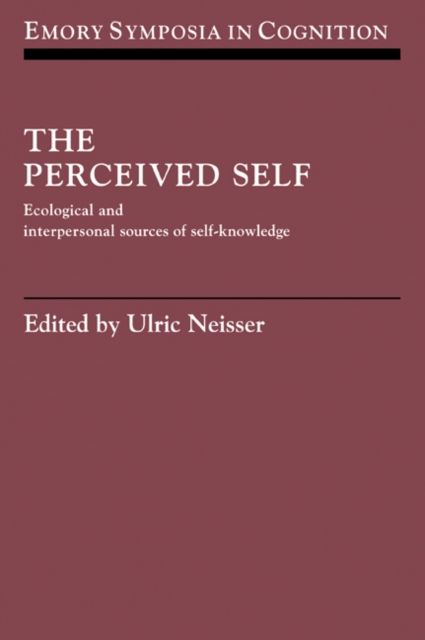
The Perceived Self : Ecological and Interpersonal Sources of Self Knowledge
Emory Symposia in Cognition
|
Innbundet
Leveringstid: 7-30 dager
Handlinger
Beskrivelse
Omtale
This book brings different ideas to bear on the classical problem of the self. Self-perception, both ecological and social, is the earliest and most fundamental form of self-knowledge. In his introduction, Ulric Neisser describes the 'ecological self' as based on direct and realistic perception of one's situation in the environment; the 'interpersonal self' as established by social interaction with other people. He argues that both of these 'selves' appear in early infancy, long before anything like a self-concept or a self-narrative is possible. In subsequent chapters, fifteen contributors - psychologists, philosophers and others - elaborate on these notions and introduce related ideas of their own. Their topics range from the perceptual and social development of infants to autism and blindness; from mechanisms of motor control to dance and non-verbal communication. The combined contributions of these leading individuals creates an unusual synthesis of perceptual, social and developmental theory.
Detaljer
-
Utgivelsesdato:
27.05.1994
-
ISBN:
9780521415095
-
Språk:
, Engelsk
-
Forlag:
Cambridge University Press -
Fagtema:
-
Serie:
Emory Symposia in Cognition
-
Litteraturtype:
-
Sider:
336
-
Høyde:
22.8 cm
-
Bredde:
15.9 cm
Andre bøker av eller med Ulric Neisser


The Conceptual Self in Context : Culture Experience Self Understanding