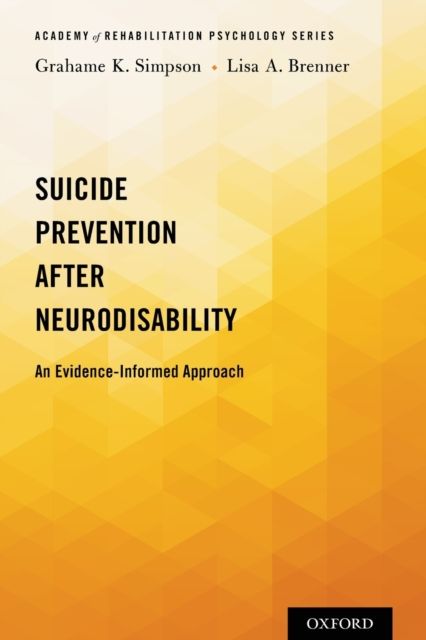
Suicide Prevention After Neurodisability : An Evidence-Informed Approach
Academy of Rehabilitation Psychology Series
|
Heftet
Leveringstid: 7-30 dager
Handlinger
Beskrivelse
Omtale
Suicide risk after disabling neurological conditions is up to five times higher than for the general population; however, knowledge about the extent of the problem, associated risk factors, and effective evidence-informed suicide prevention approaches are limited and fragmented. Suicide Prevention after Neurodisability focuses on the challenges faced by eight different types of neurodisability, namely stroke, spinal cord injury, traumatic brain injury, amyotrophic lateral sclerosis, epilepsy, Huntington's disease, multiple sclerosis, and Parkinson's disease. It pulls together the current knowledge about this risk, detailing a complex interplay between neuropathological, psychiatric, psychological, and psychosocial factors that in part account for this increased presence of suicidal thoughts and behaviors.Despite the challenges, suicide is often preventable. The best available evidence-informed approaches to suicide prevention in neurodisability are outlined, including clinical approaches to screening, suicide risk assessment, psychotherapeutic interventions, and psychosocial management. The reader-friendly approach will help make suicide prevention after neurodisability everyone's business.
Detaljer
-
Utgivelsesdato:
07.03.2019
-
ISBN:
9780199928415
-
Språk:
, Engelsk
-
Forlag:
Oxford University Press Inc -
Fagtema:
-
Serie:
Academy of Rehabilitation Psychology Series
-
Litteraturtype:
-
Sider:
288
-
Høyde:
23.1 cm
-
Bredde:
15.5 cm